Reframing Immigrant Entrepreneurship Through a Family Lens
Research on immigrant entrepreneurship has traditionally focused on male business owners or treated women as secondary contributors within family enterprises. Yet the economic strategies of immigrant families often depend heavily on women’s labour, decision-making, and adaptability. In a recent study of Bangladeshi immigrant women in Toronto, I examined how women’s entrepreneurial activities are shaped not simply by individual ambition, but by family resources, gender roles, and class position. By applying a family lens, the research highlights how entrepreneurship emerges as part of a broader household strategy to confront labour market exclusion and economic uncertainty after migration.
Migration, Downward Mobility, and Structural Barriers
Most of the women in the study arrived in Canada as spouses of skilled immigrants. Prior to migration, many had lived middle-class lives in Bangladesh, where their husbands held professional positions in banking, engineering, or other respected fields. Upon arrival in Canada, however, foreign credentials were frequently devalued, professional experience went unrecognized, and stable employment proved difficult to secure. Families that once experienced social and economic security encountered downward mobility and financial strain. In this context, women’s entrepreneurial activities must be understood as responses to structural barriers rather than simply expressions of cultural preference or personal aspiration.
Pathway One: Home-Based Entrepreneurship and Blurred Boundaries
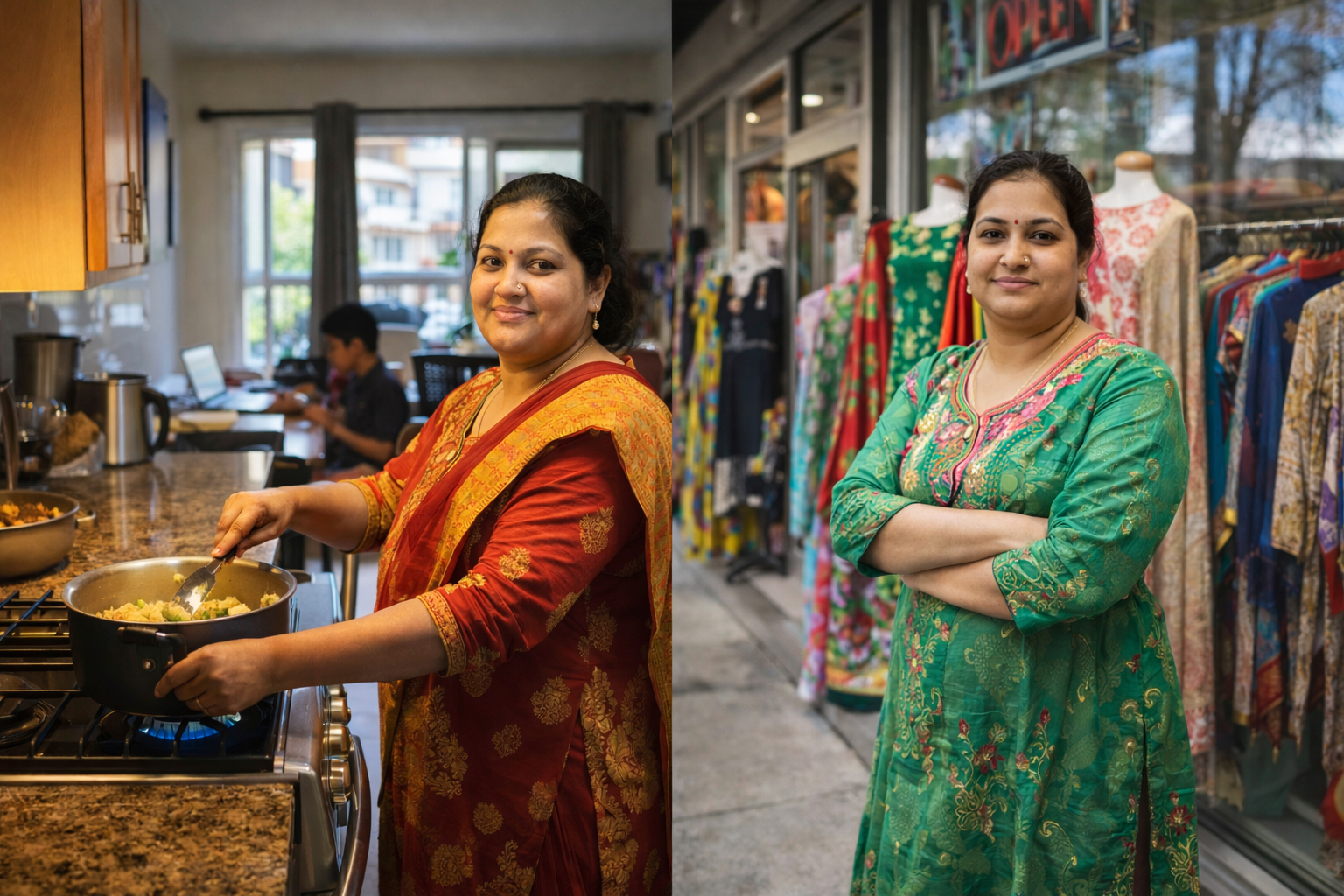
Two distinct entrepreneurial pathways emerged. One group of women established home-based businesses, including catering, sewing, childcare, beauty services, and teaching. These enterprises typically required limited financial capital and relied on skills and domestic resources already available within the household. Home-based entrepreneurship often developed when families faced immediate income shortages or when husbands were retraining to regain professional standing.
For many women, operating a business from home allowed them to contribute financially while remaining physically present to fulfill childcare and domestic responsibilities. However, the home-based model also blurred the boundary between paid and unpaid labour. Women frequently described the difficulty of separating business tasks from domestic work, as the expectation that they remain primarily responsible for household duties persisted despite their economic contributions.
Pathway Two: Non-Home-Based Businesses and Renegotiating Gender Roles
A second group of women operated non-home-based businesses, such as retail stores, restaurants, and beauty salons located in commercial areas. These enterprises required greater financial investment and were more common among families who had been in Canada longer and had accumulated savings or assets. In several cases, women’s businesses complemented those of their husbands, forming interconnected family enterprises designed to diversify income and stabilize the household’s financial position.
Notably, the spatial separation between home and workplace created conditions under which some women were able to renegotiate domestic responsibilities. Husbands and children more frequently shared household tasks when women worked long hours outside the home. In this sense, business location was not merely an economic decision; it also shaped gender dynamics within the family.
Class, Capital, and Intersectional Differences
Across both pathways, the women’s motivations were strikingly similar. They sought to stabilize family income, support children’s educational futures, and restore the middle-class status disrupted by migration. However, access to financial capital, length of residence in Canada, and class position influenced the form that entrepreneurship took. The study therefore demonstrates that even within a single ethnic and religious community, immigrant women’s economic experiences are highly differentiated. Intersectional factors—particularly gender and class—shape both opportunities and constraints.
Rethinking Agency and Immigrant Integration
This research challenges portrayals of immigrant women as passive dependents or invisible helpers in male-dominated family businesses. Instead, Bangladeshi immigrant women in Toronto emerge as active economic agents who strategically navigate structural barriers. Their entrepreneurial activities reveal how families reorganize labour, redistribute responsibilities, and deploy available resources in response to migration-induced uncertainty.
Understanding immigrant integration, therefore, requires attention not only to formal employment statistics but also to the informal and family-based economies that sustain households. The home, far from being solely a site of domestic life, can become a critical space of economic production, negotiation, and resilience.
Here is the link for the full articlein the Journal of Ethnic and Migration Studies: https://www-tandfonline-com.ezproxy.lib.torontomu.ca/doi/pdf/10.1080/1369183X.2021.2010522