Rethinking Muslim and South Asian Women Beyond Simplified Narratives
In the years following 9/11, public debates in North America and Europe have increasingly focused on Muslim immigrant women’s religious practices, dress, and participation in paid work—especially in “public” spaces. These debates often reproduce an old and damaging idea: that Muslim women form a single, uniform group whose lives are defined by oppression, restriction, and silence. At the same time, South Asian women are frequently treated as another monolithic category, flattened into a single label that obscures the deep religious, linguistic, cultural, and national differences among communities from India, Pakistan, Bangladesh, and Sri Lanka. In Placing Muslim Identity, I examine how Bangladeshi immigrant women operating businesses in Toronto complicate both of these simplified narratives. Drawing from interviews and fieldwork in Toronto’s Bangla Town, the study argues that Muslim identity is not fixed or singular; it is negotiated, context-dependent, and shaped through everyday economic and spatial practices.
The research is grounded in an intersectional approach that treats identity as something constructed at the crossroads of gender, race, ethnicity, religion, class, and place. Rather than asking whether Islam “restricts” or “liberates” women, the study asks a different question: how do Bangladeshi Muslim women actively build, express, and revise religious identity while running businesses in a neighbourhood shaped by migration, diaspora politics, and Islamophobia? The workplace, in this context, becomes a critical site where identity is performed, negotiated, and made visible.
Group Making: “Bangladeshi Muslim,” Not Just “Muslim”
One of the strongest patterns in the women’s narratives is resistance to the idea of a single “global Muslim” identity. Instead, many women present themselves as Bangladeshi Muslims, emphasizing ethnic specificity as a form of boundary-making. Statements such as “we are not like other Muslims” appear frequently, where “other” often refers to Middle Eastern Muslims or, at times, to Afghani or Pakistani Muslims. This positioning is shaped less by theological difference and more by the social climate of Islamophobia and racialized suspicion in the post-9/11 era.
Distancing from homogenized representations becomes a protective strategy—one that asserts respectability, reduces vulnerability, and claims belonging in Canadian society. At the same time, this boundary work reveals the complexity of diasporic identity politics. While resisting external stereotyping, women may also reproduce liberal/conservative binaries that circulate within Western media narratives. Their identity construction thus reflects both resistance and negotiation, shaped by multiple intersecting forces.
Body Making: Dress, Modesty, and Embodied Identity at Work
The study also explores how religious identity is negotiated through embodied practice, particularly through dress. Hijab-wearing participants reject the assumption that veiling signals withdrawal from public life. Instead, they interpret the hijab as a legitimate religious and cultural marker—comparable to visible practices in other faith traditions—that should be respected within a multicultural society. For these women, veiling becomes a means of asserting dignity, claiming space, and entering public domains on their own terms.
At the same time, non-hijab-wearing women complicate the idea that not veiling equates to assimilation or diminished religiosity. Many emphasize modesty as an ethical framework tied to behavior, family roles, and reputation rather than to a single garment. Some adopt flexible dressing strategies depending on workplace context—wearing Western clothing in mainstream workplaces to reduce social distance, while choosing Bangladeshi attire in Bangla Town to signal cultural belonging and build trust with customers. Across these variations, religious identity emerges as fluid and contextual rather than fixed.
Place Making: Re-Defining the Meaning of Public Space
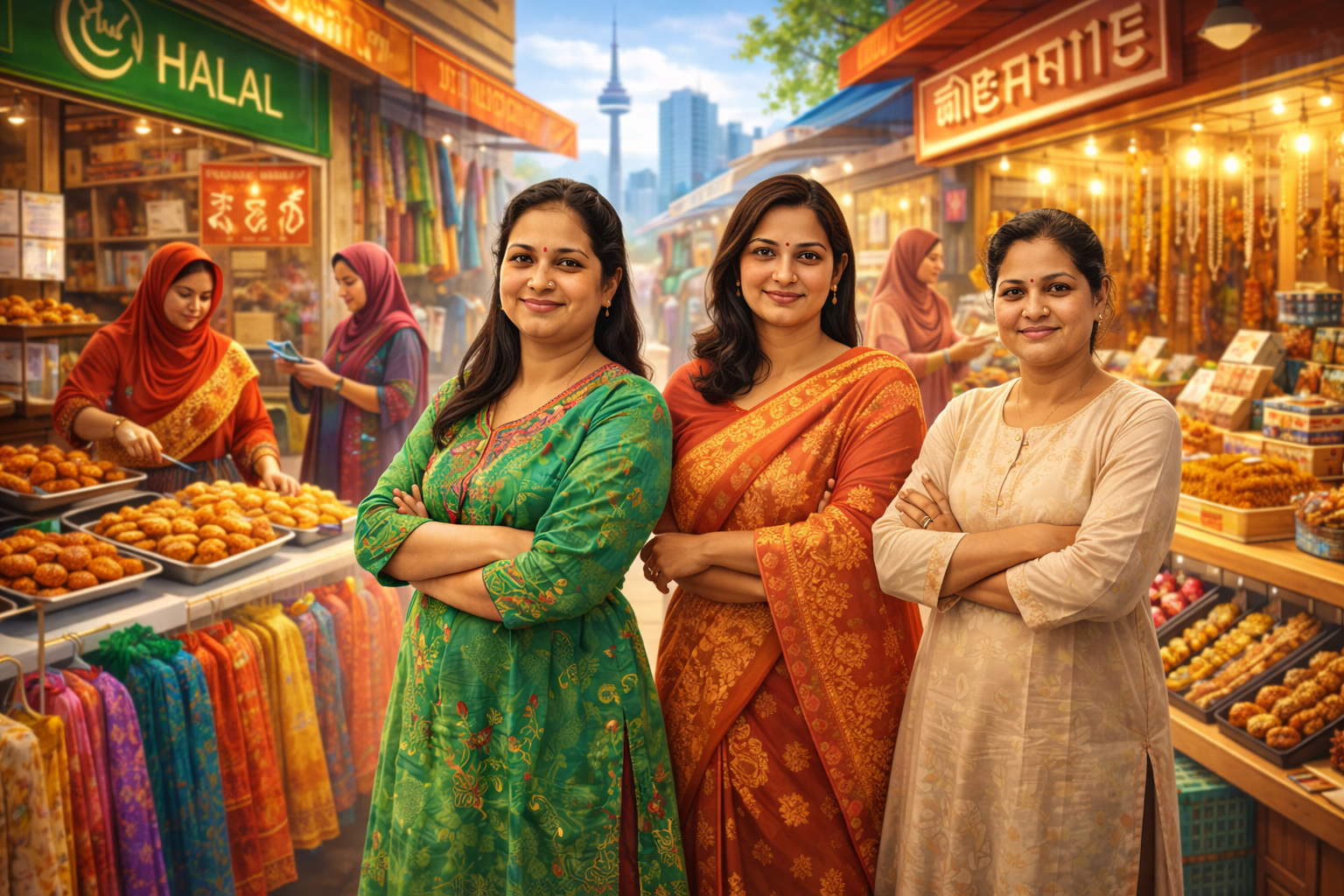
A central contribution of this work lies in its analysis of place-making. Women actively shape the meanings of their workplaces, and in doing so, redefine what public space can look like for Muslim women. Businesses are not simply economic sites; they become cultural and religious environments constructed through décor, music, menus, hiring practices, and customer engagement.
Some women foreground Bengali identity and cultural pluralism, creating spaces that celebrate Bengali festivals, language, and everyday social life. By serving both halal and non-halal food or hiring across religious lines, they construct inclusive spaces that appeal to diverse Bangladeshi communities. Others emphasize religious identity more explicitly, creating Muslim-oriented environments through Islamic imagery, halal-only menus, and spiritual ambience that attract Muslim customers from multiple ethnic backgrounds. Still others challenge conservative gender expectations directly—operating unisex businesses and serving male customers—justifying these practices through hybrid Canadian-Bangladeshi identities and a distinction between professional and moral boundaries.
In each case, identity and space are co-constructed. Women define their workplaces, and their workplaces, in turn, shape how they experience and perform identity.
Agency, Diversity, and Intersectionality
Taken together, these narratives disrupt Orientalist portrayals of Muslim women as passive subjects of tradition. They also challenge the homogenization of South Asian women as a singular ethnic category. The women in this study engage actively in group making, body making, and place making—drawing boundaries, embodying religious and cultural meanings, and shaping neighbourhood spaces through everyday business practices.
Their stories underscore the importance of recognizing diversity within Muslim and South Asian diasporic communities in Canada. Religious identity is not simply carried into the workplace; it is produced, negotiated, and reshaped there. While this study focuses on Bangladeshi women in Bangla Town, it also raises further questions about how identity negotiations unfold in mixed or non-ethnic neighbourhoods. Understanding these dynamics requires continued research that takes seriously the intersection of gender, religion, ethnicity, and place.
Reference for the full Book chapter: Akbar, M. (2025). Placing Muslim identity: Experiences of Bangladeshi immigrant women operating businesses in Toronto. In A. Jamal et al. (Eds.), South Asian Feminisms in Diaspora: Critical Perspectives from Canada. University of Alberta Press.
Link for the Book: