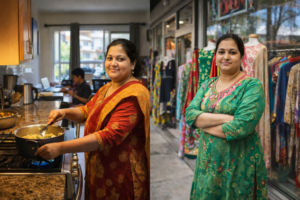
Bangladesh is often presented as a success story in women’s development. The ready-made garments sector employs approximately four million workers — the majority of them women — and serves as the backbone of the country’s export economy. In many districts, girls’ enrollment in secondary education equals or even surpasses that of boys. Women’s visibility has increased across universities, NGOs, the civil service, media, and political leadership.
Yet alongside this progress, a deeper and troubling reality persists — one marked by violence, hostility, and humiliation. According to data from the Bangladesh Bureau of Statistics, more than half of married women have experienced intimate partner violence at some point in their lives. Reports of sexual harassment and assault regularly surface. Online, hateful language and abuse directed at women journalists, activists, and professionals spread rapidly.
This contradiction — progress alongside hostility — is not merely a byproduct of social change. It is also being politically mobilized.
Jamaat-e-Islami and the Narrative Against Women
Recent statements from Jamaat-e-Islami Bangladesh are particularly alarming. Labeling working women in degrading terms, proposing reductions in their working hours, advocating mandatory dress codes (hijab or burqa), and even suggesting restrictions on women’s mobility without male guardians — these are not simply religious opinions. They are proposals for social and political control.
The issue here is not religious belief. The question is whether women’s citizenship and economic participation are being strategically framed as political tools.
When a political force characterizes working women as symbols of “moral decay,” it is not merely targeting women. It is attempting to redefine the character of public space. Women’s bodies, dress, and mobility become central to broader identity politics.
From Inclusion to Backlash
Today, women in Bangladesh participate in the labor market, education, and public life in unprecedented numbers. This transformation has shifted power balances within families and society. But when economic change is not matched by institutional protection and evolving social norms, backlash emerges.
Sociologists describe this as “patriarchal backlash” — when women’s advancement is perceived as a threat to established hierarchies, efforts to reassert control intensify.
This backlash rarely presents itself as opposition to equality. Instead, it appears in the language of protecting religion, culture, or national values. Women’s freedom becomes a measure of national morality.
Economic Insecurity and Political Simplification
Youth unemployment and underemployment among educated young people remain serious challenges in Bangladesh. Inflation and competition in urban labor markets have intensified economic pressure. In such circumstances, uncertainty around traditional male breadwinner roles increases.
In this context, it becomes easier to frame women’s income and independence as the problem. Instead of addressing structural challenges — skills mismatches, industrial limitations, weak research investment — public discourse shifts toward regulating women’s dress and mobility.
This is politically convenient. Structural reform is difficult. Moral panic is easier to mobilize.
Normalization in the Digital Age
Social media accelerates this process. Degrading language spreads quickly. Women are publicly labeled and shamed. Insults are reframed as humor. Over time, what was once unacceptable becomes normalized.
When degrading rhetoric toward working women gains political legitimacy, it sends a dangerous message: women’s rights are conditional.
The Spirit of 1971 and Today’s Reality
In 1971, women were organizers, freedom fighters, and survivors of violence. Their dignity formed part of the moral foundation of the nation. The aspiration of independence was collective dignity and autonomy.
Calls today to restrict women’s mobility or economic participation narrow that founding vision. They redefine citizenship in gendered terms.
Final Reflection
Misogyny in Bangladesh cannot be dismissed as isolated prejudice. It is intertwined with economic pressure, identity politics, and power struggles. When women’s autonomy is portrayed as the source of social crisis, it becomes a political organizing tool.
But the long-term costs are severe. Limiting women’s labor force participation constrains economic growth. Normalizing gender-based hostility weakens democratic tolerance.
The question, therefore, is not only about women’s rights. It is about national direction. Will Bangladesh pursue structural reform? Or will it choose the easier path of regulating women’s visibility?
Misogyny may offer short-term political advantage. In the long term, it is socially corrosive and economically self-defeating.